



<< airspeed | airspeed indicator | airway >>
Back to: "A"
airspeed indicator
- Definição1
- A differential air pressure gage which measures the difference between ram, or impact, air pressure and the local static air pressure. The dial of an airspeed indicator is calibrated to convert this differential air pressure into units of knots, moles per hour, or kilometers per hour.
- Fonte1
- CRANE, Dale (ed.). Dictionary of aeronautical terms. 2nd ed. Renton: ASA, 1991.
- Definição2
- A differential pressure gauge that measures the dynamic pressure of the air through which the aircraft is flying. Displays the craft’s airspeed, typically in knots, to the pilot.
- Fonte2
- FEDERAL AVIATION ADMINISTRATION. Pilot's handbook of aeronautical knowledge. [s.l.], 2008. Disponível em: http://www.faa.gov/regulations_policies/handbooks_manuals/aviation/pilot_handbook/media/PHAK%20-%20Cover-Preface.pdf. Acesso em: 26 jun. 2014.
- Fonte3
- CAMPOS, M. C.; PAIVA, P. T.; PRICEVICIUS, T.; VARANDA, T. V. C. Glossário de aviação. São Paulo: Núcleo de Estudos de Tradução, 2002.
- Fonte4
- FEDERAL AVIATION ADMINISTRATION. Rotorcraft flying handbook (FAA-H-8083-21). Washington, DC: FAA, 2000. Disponível em:
- Nota Adicional1
- Acronym in English: ASI.
- Contexto
- The position of the pitot tube and the attitude of an aircraft can affect the accuracy of the airspeed indicator.
- Whenever the airspeed is changed any appreciable amount, the torque meter is momentarily the primary instrument for power control. When the airspeed approaches that desired, the airspeed indicator again becomes the primary instrument for power control.
- Ver
- anemometer
- Français
- indicateur de vitesse
- Imagem
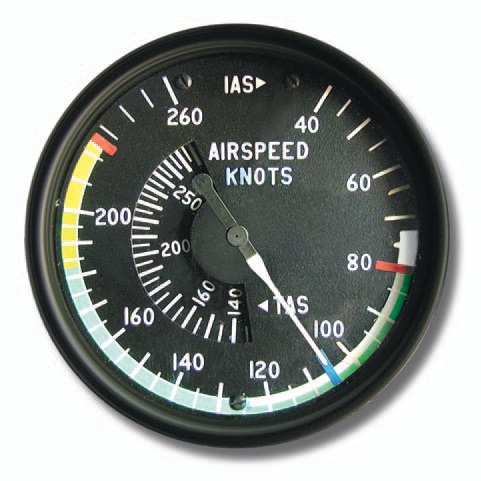
Velocímetro de um avião multi-motor.
Fonte: http://upload.wikimedia.org/wikipedia/commons/8/8e/FAA-8083-3A_Fig_12-1.PNG
