



<< aileron roll | ailerons | aiming point >>
Back to: "A"
ailerons
- Definição1
- A primary flight control surface mounted on the trailing edge of the wing, which controls the rolling movement of the aircraft or its rotation about its longitudinal axis. The ailerons move differentially - the up-going aileron is on the side where the aircraft is banked, whereas the down-going aileron is on the side of the up-going wing.
- Fonte1
- KUMAR, Bharat (ed.). An illustrated dictionary of aviation. New York: McGraw-Hill, c2005. 752 p.
- Definição2
- Primary flight control surfaces mounted on the trailing edge of an airplane wing, near the tip. Ailerons control roll about the longitudinal axis.
- Fonte2
- INTERNATIONAL CIVIL AVIATION ORGANIZATION. Aircraft accident digest n.24. Montreal, 1982. (Cir. 166 AN/105).
- Definição3
- Pairs of control surfaces, normally situated at a trailing edge of the wing structure, designed to control an aircraft in roll by their differential movement.
- Fonte3
- INTERNATIONAL CIVIL AVIATION ORGANIZATION. Aircraft accident digest n.25. Montreal, 1983. (Cir. 172 AN/108).
- Fonte4
- FEDERAL AVIATION ADMINISTRATION. Pilot's handbook of aeronautical knowledge. [s.l.], 2008. Disponível em: http://www.faa.gov/regulations_policies/handbooks_manuals/aviation/pilot_handbook/media/PHAK%20-%20Cover-Preface.pdf. Acesso em: 26 jun. 2014.
- Contexto
- The aileron and flaps remained attached to the wing.
- A rolling takeoff was made, takeoff thrust was stabilized at 80 KIAS, arid left rudder and right aileron were used to compensate for the right crosswind.
- Subárea
- Aircraft Structure
- Spanish
- alerón
- Imagem
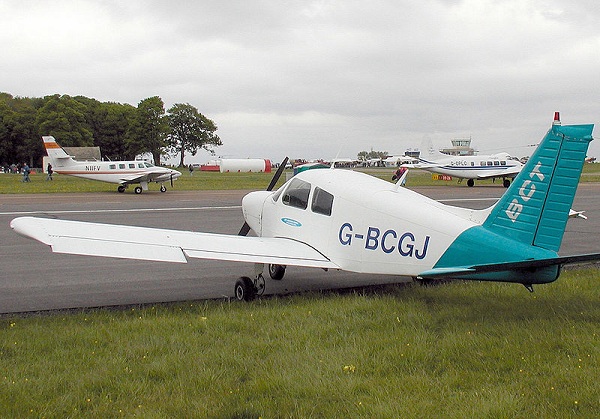
On this parked Piper Cherokee, the left aileron has deflected downwards, and the right, upwards.
Fonte: http://en.wikipedia.org/wiki/File:Piper.cherokee.pa-28-140.g-bcgj.arp.jpg
